


Honda Indy Racing Car
Racing Car Honda Indy project concept has been designed to offer superior aerodynamic performance.
The Honda and the Indy Racing League was sponsored by Honda Indy Racing Car project. Yutian Li,the vehicle's designer, is a graduate of the Transportation Design course at the College for Creative Studies in Detroit, Michigan. Yutian also holds a bachelors degree in vehicle engineering and a masters in industrial design from Tsinghua University in Beijing, China.
The overall shape of the Honda Indy Racing Car was inspired by modern architecture - but more specifically Zaha Hadid's work which is greatly influenced by topological patterns found in nature and has a high degree of fluidity and continuity. Yutian applied this theme to vehicle design by using a combination of blended surfaces, and crossing/overlapping shapes in order to bring a whole new look to the future Indy Car Series.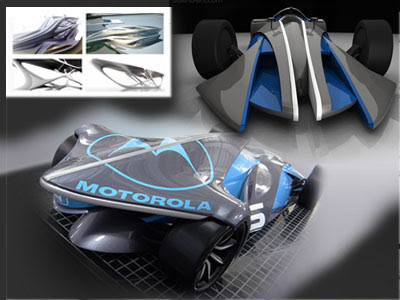
Honda Indy Racing Car
Aside from bringing completely new forms to the racing world, the Honda Indy Racing Car has also been designed to offer superior aerodynamic performance. The large integrated rear wing located above the engine creates downforce over the rear axle. This downforce is increased once the engine is up at operating temperature because of the pressure difference between hot and cold air. The side panel directs the air to go around the wheels so that rotating drag is reduced. The air box on either side of the driver and the large air intakes in the front ensure sufficient airflow to the engine.
As with all racing vehicles, driver safety in the event of a crash is the utmost priority. The driver of the Honda Indy Racing Car concept is protected by a structure which was inspired by the shape of leaves. This unit is designed to diffuse the energy of the collision, and at the same time keep the interior cockpit structure intact.
Aside from keeping the rear tires firmly in contact with the track surface, the expansive rear spoiler also acts as a prominent billboard which could make the Indy series more attractive to sponsors. The stripe which divides this spoiler in two contains a thermally sensitive material which changes color depending on engine temperature. This is designed to add more excitement to the race and the spectators.
The Honda and the Indy Racing League was sponsored by Honda Indy Racing Car project. Yutian Li,the vehicle's designer, is a graduate of the Transportation Design course at the College for Creative Studies in Detroit, Michigan. Yutian also holds a bachelors degree in vehicle engineering and a masters in industrial design from Tsinghua University in Beijing, China.
The overall shape of the Honda Indy Racing Car was inspired by modern architecture - but more specifically Zaha Hadid's work which is greatly influenced by topological patterns found in nature and has a high degree of fluidity and continuity. Yutian applied this theme to vehicle design by using a combination of blended surfaces, and crossing/overlapping shapes in order to bring a whole new look to the future Indy Car Series.

Honda Indy Racing Car
Aside from bringing completely new forms to the racing world, the Honda Indy Racing Car has also been designed to offer superior aerodynamic performance. The large integrated rear wing located above the engine creates downforce over the rear axle. This downforce is increased once the engine is up at operating temperature because of the pressure difference between hot and cold air. The side panel directs the air to go around the wheels so that rotating drag is reduced. The air box on either side of the driver and the large air intakes in the front ensure sufficient airflow to the engine.
As with all racing vehicles, driver safety in the event of a crash is the utmost priority. The driver of the Honda Indy Racing Car concept is protected by a structure which was inspired by the shape of leaves. This unit is designed to diffuse the energy of the collision, and at the same time keep the interior cockpit structure intact.
Aside from keeping the rear tires firmly in contact with the track surface, the expansive rear spoiler also acts as a prominent billboard which could make the Indy series more attractive to sponsors. The stripe which divides this spoiler in two contains a thermally sensitive material which changes color depending on engine temperature. This is designed to add more excitement to the race and the spectators.


